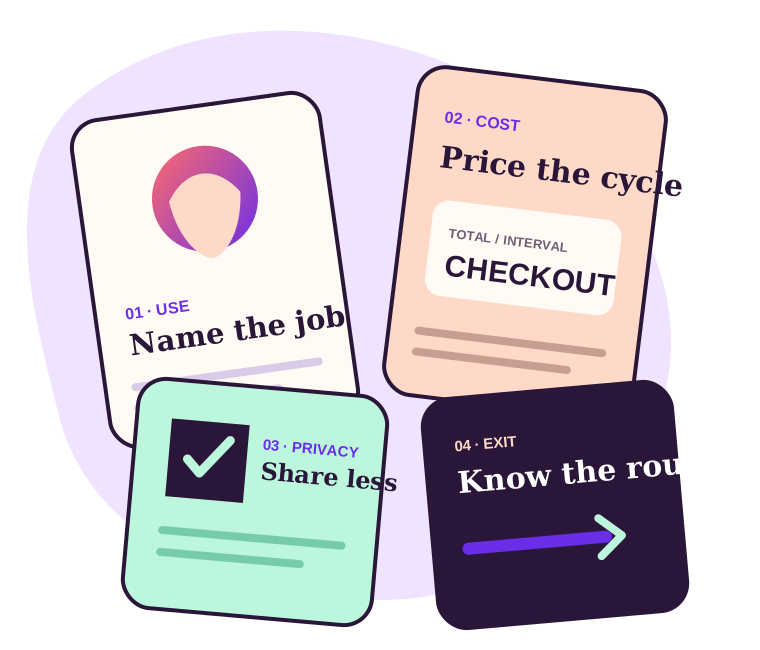
Which service handles your chosen task at a clearer total cost?
Compare conversation fit, media cost, controls and exit using current official screens.
Begin with the page the operator controls.
Product details, availability and prices can change. Read the current source before you run the check, then use the live account or checkout screen when it provides more specific information.
Official Kupid AI subscriptionshttps://www.kupid.ai/subscriptions ↗Source checked for this publication on July 31, 2026. That date records our review, not a promise that the page will remain unchanged.
Run a small test you can repeat.
- 1
Choose one chat and one media task.
- 2
Record current plan totals from each official checkout.
- 3
Check cancellation and deletion routes before scoring.
Keep the profile fictional, adult and free of identifying information. Write down what happened instead of filling gaps with assumptions. If the result matters to billing, privacy or your ability to leave, confirm it on the current official screen.
Finish with a compact evidence note: the question you asked, the source URL and date, the account or device used, what you observed, and what remains unknown. Save price and policy screens when they affect the decision. This record makes a later comparison fair and prevents a memorable answer from replacing the full result.
A result can look stronger than it is.
This protocol does not claim a winner without your current test results.
Promotional examples show what a product is designed to do; they do not establish what every user, character, plan or device will deliver. Separate what the operator states from what you personally observe.
Pause if the cost, consent, privacy rule or account control is unclear. Ask official support rather than making an irreversible guess.
A deeper, reproducible decision process
A fair Kupid AI vs Candy AI comparison uses the same buyer job, prompts, device, time window and budget ceiling on both services. This section does not declare a universal winner and does not convert either company’s marketing into a tested fact.
Start with one shared buyer job
Write the routine you want both products to perform. Keep it narrow enough to observe: a repeat text conversation with one fictional character, a character-building session, or a limited set of visual outputs. Choose three must-haves and two deal-breakers before opening either service. Without that step, the second product tested often loses simply because novelty has faded or the evaluator changes standards mid-comparison.
Create a blank scorecard with conversation control, continuity, creation fit, media usefulness, full-cycle cost, account controls, and documentation clarity. Weight only the categories that matter to the stated job. Do not award points for a feature you will not use, and do not subtract points merely because the services organize similar outcomes differently. Mark unavailable evidence unknown rather than zero.
Run the same low-risk interaction sequence
Use identical fictional prompts in the same order: establish a preference, ask for a short scene, change one condition, and return to an earlier detail. Record how much correction each service needs and whether the interface makes steering obvious. Do not compare one carefully configured character against a random default on the other platform. Spend roughly equal setup time and document any unavoidable difference.
Repeat on a later session to check whether the first result was representative. Avoid publishing private transcripts, explicit personal material, or real-person likenesses. The score should reflect controllability, coherence, and recovery from a change, not whether one output happens to match the evaluator’s taste. If behavior varies materially between sessions, record the range instead of selecting the best output as the winner.
Compare creation and media as workflows
For character creation, compare the path from intention to usable character. Count meaningful decisions, unclear controls, required retries, and whether the result reflects the inputs. For media, define one safe fictional brief and test only within the access and budget you have deliberately chosen. A large catalog or a prominent button is not proof that the feature is useful for your routine.
Record output consistency, wait time, ability to revise, and the incremental cost of obtaining one acceptable result. If a feature is unavailable without payment, say not tested rather than copying a promotional claim. Compare deletion, download, and visibility controls alongside output quality. A visually strong result can still be a poor fit if repeated use is unpredictable, expensive, or uncomfortable to manage.
Normalize cost before choosing a winner
Open each current checkout and compare the same commitment length. Record amount due now, renewal amount, currency, included allowances, and variable-use rules. Do not compare Kupid’s shortest plan with Candy’s longest discounted equivalent. Promotions and geographic pricing can differ, so retain the date and account context. The final checkout is more reliable than a search snippet or old review.
Model the same weekly routine on both products. Include expected retries and optional media only when they are part of that routine. Calculate a low-to-high full-cycle range and cost per useful session. If one product has clearer pricing but a higher observed total, keep those as separate findings. Transparency is valuable, but it does not erase cost; lower cost is useful, but it does not erase uncertainty.
Compare privacy and exit controls independently
Read each current privacy policy and terms document rather than assuming the products share category norms. Create rows for data you must provide, data you can avoid, processing and sharing language, retention, account deletion, subscription cancellation, and support. A missing answer should remain unresolved. Do not translate generic security language into a guarantee of confidentiality or immediate erasure.
Before entering sensitive material, test whether you can find account settings, content controls, support, and the subscription exit path. Use unique credentials and fictional profile details where allowed. If one platform documents an important control more clearly, that is evidence of documentation quality—not proof that every backend outcome is better. Keep policy evidence and interface evidence labeled separately.
Choose by scenario, then schedule a recheck
A useful conclusion names the scenario in which each service fits. The text-first buyer, visual creator, occasional user, and budget-sensitive buyer may reach different outcomes from the same observations. Require every recommendation to point to a scorecard row and a dated source. If a hard deal-breaker fails, do not let a high average score hide it.
Take the smallest reversible next step: remain unpaid, buy the shortest suitable interval, or leave. Set a reminder before renewal and rerun the categories most likely to change—price, allowances, interface, and policy. This makes the comparison durable without pretending the 2026 product state is permanent. It also prevents affiliate links from becoming the reason for the verdict rather than a disclosed route after the decision is made.
Keep the result auditable
Before publishing or relying on the result, perform a symmetry check. Confirm that both products received the same number of sessions, approximately equal setup effort, the same fictional prompts, the same spending ceiling and the same standard for an acceptable output. Note any unavoidable asymmetry, such as a feature being locked, a promotion applying to only one account or a control existing under a different name. Then ask whether removing the most visually impressive moment would change the verdict. If it would, the comparison may be rewarding novelty rather than repeated-use value. Finally, verify every outbound claim against its dated source and keep affiliate destinations outside the score. The commercial route can help fund the publication, but it cannot earn points for either product. This final pass makes the conclusion easier to audit and less likely to become a stale winner badge after a checkout, policy or interface change. Record who performed the check and which evidence was unavailable.
Sources to open during the check
- Kupid subscriptions
- Kupid terms of service
- Kupid privacy policy
- Kupid character creator
- Candy AI official product surface
Source list reviewed July 31, 2026. Live interfaces and checkout details can vary; record the date and account context of your own observation.
Turn the evidence into a boundary.
Pick the clearer fit, not the longer feature list.
A useful choice does not require perfect certainty. It does require a clear main use, an affordable full billing cycle, acceptable handling of your information and a known exit route. Unknowns that affect those four areas should reduce confidence, not disappear from the score.
Ready to check the current Kupid AI experience?
We may earn a commission if you join. It does not increase your price.