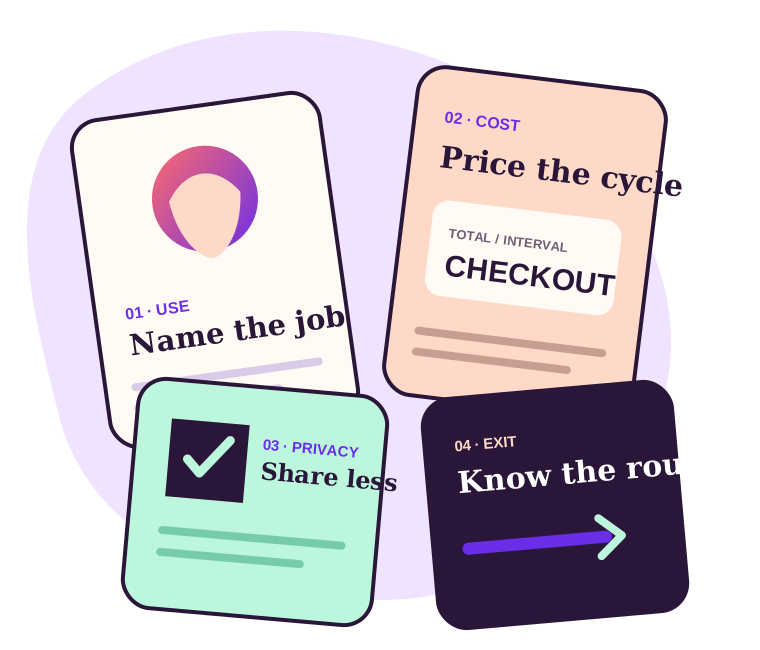
Which product gives you enough creative control without hidden friction?
A repeatable test for character creation, continuity, media and price.
Begin with the page the operator controls.
Product details, availability and prices can change. Read the current source before you run the check, then use the live account or checkout screen when it provides more specific information.
Official Kupid AI character creatorhttps://www.kupid.ai/create-ai-girlfriend ↗Source checked for this publication on July 31, 2026. That date records our review, not a promise that the page will remain unchanged.
Run a small test you can repeat.
- 1
Use the same fictional adult character brief.
- 2
Repeat one conversation and one media task.
- 3
Price retries and premium actions, not just entry cost.
Keep the profile fictional, adult and free of identifying information. Write down what happened instead of filling gaps with assumptions. If the result matters to billing, privacy or your ability to leave, confirm it on the current official screen.
Finish with a compact evidence note: the question you asked, the source URL and date, the account or device used, what you observed, and what remains unknown. Save price and policy screens when they affect the decision. This record makes a later comparison fair and prevents a memorable answer from replacing the full result.
A result can look stronger than it is.
Do not treat different promotional examples as equivalent tests.
Promotional examples show what a product is designed to do; they do not establish what every user, character, plan or device will deliver. Separate what the operator states from what you personally observe.
Pause if the cost, consent, privacy rule or account control is unclear. Ask official support rather than making an irreversible guess.
A deeper, reproducible decision process
Kupid AI vs OurDream should be evaluated as two complete workflows, not as competing lists of promotional features. The protocol below keeps the comparison dated, reversible and focused on the routine the buyer actually wants.
Choose a comparable use case
Define one fictional companion brief that can be attempted on both services without personal data. Specify tone, two character traits, one boundary, and the type of recurring interaction you expect. Decide in advance whether text, visual creation, voice, or another current feature is essential. If the products expose different controls, compare the resulting ability to achieve the same outcome rather than rewarding the service with more menu items.
List three acceptance tests and two stop conditions. Acceptance might include maintaining the requested tone, allowing a clear correction, and making costs visible before a paid action. Stop conditions might include unclear renewal language or a required disclosure you are unwilling to make. Freeze this scorecard before testing so the verdict cannot be rewritten around whichever interface initially feels more exciting.
Measure setup friction and character control
Time the path from account entry to a usable fictional character, but do not confuse fewer steps with better control. Record whether each decision is understandable, whether defaults are obvious, and whether changes can be previewed or revised. Use equivalent effort on both platforms. If one requires a different workflow, document the difference rather than forcing an artificial step-for-step match.
After setup, ask the same neutral questions and introduce the same change of direction. Note how each system responds to correction and whether the chosen traits remain recognizable. Repeat after a break. One fluent reply does not establish long-term memory, and one confused reply does not prove permanent failure. The evidence is the observed sequence, date, access level, and amount of steering required.
Audit visual and multimedia value carefully
If visual or voice features matter, select a small, non-identifying fictional brief and a hard spending ceiling. Check which features are actually available to the current account and which require a plan or variable balance. Record the cost shown before each action, retries, failed attempts, and whether the output remains consistent with the character. Marketing images are not a substitute for an account-level test.
Judge the complete workflow: generation, revision, organization, visibility, download, and deletion controls. A service can produce an appealing first output while remaining cumbersome for repeated use. Conversely, a simpler result can be more useful if it is predictable and easy to manage. Keep visual quality, controllability, cost, and privacy as separate rows so one impressive artifact does not decide the entire comparison.
Create equal full-cycle budgets
Record both live checkouts on the same day where possible. Capture currency, immediate charge, renewal charge, interval, included use, and any variable units needed for the planned routine. Do not compare a temporary entry offer on one service with a recurring amount on the other. When a number is unavailable without account progression, mark it unverified and do not fill the gap from memory.
Project low, normal, and heavy scenarios using the same weekly actions. Include media retries only when the test shows they are likely. Divide each full-cycle estimate by useful sessions or accepted outputs. This exposes whether a lower subscription shifts cost into variable use and whether a broader plan includes value you will never use. The result should be a range with assumptions, not a universal “cheaper” badge.
Read policy, renewal and account-exit evidence
Review each service’s current terms and privacy material for age requirements, prohibited use, renewal, cancellation, data handling, retention, and account rights. Record exact source URLs and dates. Do not infer that similar product categories have identical rules. If the service points to in-product settings or support for an action, verify that path while the account is accessible.
Use a unique email and password and avoid real identities, private photos, financial details beyond the payment process, and personal secrets. Find the subscription-management and deletion routes before committing. If a key answer remains unclear, ask support and pause the purchase. The comparison should reward clear evidence without claiming that documentation alone proves every operational outcome.
Make a scenario verdict, not a brand verdict
Summarize where Kupid and OurDream each passed, partially passed, failed, or remained unknown for the chosen job. Keep hard stop conditions visible. A product can lead on character control and still lose for a buyer with a strict variable-spend ceiling; another can offer broad media options and still be excessive for someone who wants only text. Name those trade-offs directly.
Select the smallest reversible action and schedule a checkpoint before renewal. Revisit price, included allowances, the feature used most often, and the policy question with the greatest impact. If the routine changes, create a new scorecard rather than stretching the old verdict. This keeps the comparison honest, protects against stale claims, and makes the commercial link a disclosed next step rather than the source of the recommendation.
Keep the result auditable
Run a final workflow replay before choosing. Begin at the home or account screen, locate the character, start the planned interaction, perform the one media action that matters, check remaining value and find the exit controls. Record where either service creates uncertainty or requires a workaround. This replay is more revealing than counting features because it measures the complete path a returning buyer would repeat. Next, remove capabilities that are interesting but outside the stated job and recalculate the score. A broad creative tool should not win a text-only decision merely because it offers more possibilities, and a simpler companion should not win a media-heavy decision merely because its navigation feels familiar. Preserve screenshots only when they contain no sensitive information, date every checkout and policy observation, and keep unknowns visible. If the result depends on an unavailable paid feature, the honest verdict is conditional until a bounded test is justified—not a confident recommendation copied from promotional material. Preserve the reason for every conditional score.
Sources to open during the check
- Kupid subscriptions
- Kupid terms of service
- Kupid privacy policy
- Kupid character creator
- OurDream official product surface
Source list reviewed July 31, 2026. Live interfaces and checkout details can vary; record the date and account context of your own observation.
Turn the evidence into a boundary.
Prefer the service that reproduces your brief consistently within a known budget.
A useful choice does not require perfect certainty. It does require a clear main use, an affordable full billing cycle, acceptable handling of your information and a known exit route. Unknowns that affect those four areas should reduce confidence, not disappear from the score.
Ready to check the current Kupid AI experience?
We may earn a commission if you join. It does not increase your price.