Which service sustains your normal session with fewer unresolved limits?
A controlled comparison for conversation continuity, controls and billing.
Begin with the page the operator controls.
Product details, availability and prices can change. Read the current source before you run the check, then use the live account or checkout screen when it provides more specific information.
Official Kupid AI overviewhttps://www.kupid.ai/ ↗Source checked for this publication on July 31, 2026. That date records our review, not a promise that the page will remain unchanged.
Run a small test you can repeat.
- 1
Write one 20-turn fictional scenario.
- 2
Use the same boundaries on both products.
- 3
Read both current policies before sharing any personal detail.
Keep the profile fictional, adult and free of identifying information. Write down what happened instead of filling gaps with assumptions. If the result matters to billing, privacy or your ability to leave, confirm it on the current official screen.
Finish with a compact evidence note: the question you asked, the source URL and date, the account or device used, what you observed, and what remains unknown. Save price and policy screens when they affect the decision. This record makes a later comparison fair and prevents a memorable answer from replacing the full result.
A result can look stronger than it is.
A single memorable reply is not evidence of reliable continuity.
Promotional examples show what a product is designed to do; they do not establish what every user, character, plan or device will deliver. Separate what the operator states from what you personally observe.
Pause if the cost, consent, privacy rule or account control is unclear. Ask official support rather than making an irreversible guess.
A deeper, reproducible decision process
This Kupid AI vs Joi protocol emphasizes controllability, repeated-use fit and evidence quality. It does not assume that a plan, feature or free path seen by one account is available to every visitor.
Freeze the decision criteria first
Write one sentence describing the desired relationship with the product: short fictional chat, continuing character narrative, visual experimentation, or another defined routine. Assign weights to conversation steering, continuity, media, cost, privacy documentation, and exit controls. Add deal-breakers such as an unclear recurring charge or an inability to locate account support. Freeze the sheet before visiting either checkout.
Use the same account-risk posture on both services: unique credentials, fictional details where permitted, no real-person intimate material, and no sensitive facts. A comparison becomes misleading when one service receives extensive personalization and the other receives a casual default session. Equivalent effort and equivalent risk are part of the method, even if the interface paths differ.
Compare steering and recovery
Run a four-part fictional exchange: define a tone, introduce a harmless fact, request a scene change, and ask the character to return to the earlier fact. Record the number and type of corrections needed. Then introduce a boundary or pause and observe whether returning to a neutral direction is straightforward. The purpose is not to provoke the system; it is to test whether the user remains in control of an ordinary fictional interaction.
Repeat the exchange later with the same character or closest equivalent. Label any memory result as an observation, not a guarantee. If a response is inconsistent, record whether a clear reminder repairs it. Score recovery separately from first-pass fluency because a companion used over time must handle corrections, not merely produce one impressive answer.
Evaluate account and notification comfort
Inspect the controls that affect everyday privacy: profile visibility, content organization, notifications, audio behavior, and the ability to sign out or secure the account. Test on the device you expect to use. A feature that feels private on a desktop can create unwanted exposure through lock-screen previews or audio in a shared environment. Configure conservative settings before experimenting.
Do not equate a private-feeling interface with a technical privacy guarantee. Read each current privacy policy for what is collected, why it is processed, how it may be shared, retention language, and rights. When an answer is not clear, list it as unresolved. Compare the clarity of evidence and available controls, not assumptions about the brands.
Test only the media that matters
If images or voice are part of the buyer job, verify current availability in each account and use one safe fictional brief. Record access requirements, the displayed cost before action, time to result, revision controls, and whether the result stays consistent with the character. Do not use promotional examples as output-quality evidence and do not purchase a long plan simply to unlock a comparison test.
Count retries and rejected outputs in the practical cost. Check whether generated material can be managed or deleted and whether it appears in a private account area. Score novelty, repeatability, and control separately. The right media tool is the one that supports the planned routine predictably within the budget and privacy posture—not necessarily the one with the most prominent demo.
Normalize subscription and variable spend
Open the current Kupid and Joi plan surfaces and final checkouts. Record date, currency, charge today, renewal amount, billing period, included allowances, and any separate units used for desired features. Prices can vary by region, term, promotion, or account, so do not turn one checkout into a universal table. Use current terms to clarify renewal and cancellation where possible.
Model the exact same weekly routine on each service. Produce low, normal, and heavy ranges and calculate cost per useful session. If information is inaccessible, preserve an unknown rather than guessing. A product can win on predictable cost even if its headline amount is higher, while another can win on flexibility for a light user. Keep those scenarios explicit rather than forcing one cheapest label.
Resolve the comparison by buyer type
Summarize the scorecard for a text-first user, a media-first user, an occasional tester, and a privacy-cautious buyer only when the observations support those distinctions. Every conclusion should trace back to a dated interface observation, checkout, policy, or clearly labeled unknown. Do not convert publisher payout, popularity, or an affiliate route into a product benefit.
Choose an unpaid test or shortest suitable commitment, then schedule a review before renewal. Recheck the plan, the variable unit rules, the most-used feature, and the account-exit path. If a new feature appears, treat it as a new test item rather than rewriting the old observation. This makes the Kupid versus Joi page useful even as the products change and prevents a stale winner claim from surviving after its evidence expires.
Keep the result auditable
Add a confidence column beside every Kupid and Joi score. Use high confidence only for a repeatable live observation or clear current contractual language, medium confidence for a single account-level observation, and low confidence for an unresolved or third-party signal. A numerical difference with low confidence should not decide the winner. Recheck the rows with the largest decision impact: steering after a correction, cost of the normal routine, notification or account exposure, renewal, and the ability to stop. Also verify that plan labels and variable units have not been treated as equivalent merely because both services use a paid tier. Their scope may differ and must be translated into the same buyer outcome. End by recording the observation date, device, region or currency when relevant, and whether payment was involved. This context limits overgeneralization and gives the next editor a precise update path instead of forcing a full rewrite from stale prose. If a source changes between the two checks, retain both dates and explain which version controlled the verdict. Do not silently combine observations from different plans, devices or regions. A later editor should be able to reproduce the comparison boundary before deciding whether a fresh test is needed.
Sources to open during the check
- Kupid subscriptions
- Kupid terms of service
- Kupid privacy policy
- Kupid character creator
- Joi official product surface
Source list reviewed July 31, 2026. Live interfaces and checkout details can vary; record the date and account context of your own observation.
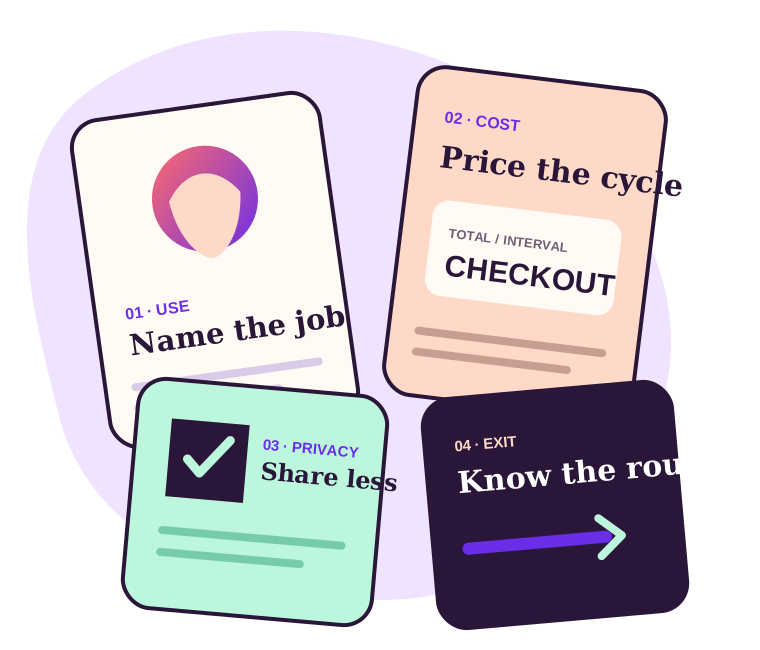
Turn the evidence into a boundary.
Choose only after both products face the same task and evidence standard.
A useful choice does not require perfect certainty. It does require a clear main use, an affordable full billing cycle, acceptable handling of your information and a known exit route. Unknowns that affect those four areas should reduce confidence, not disappear from the score.
Ready to check the current Kupid AI experience?
We may earn a commission if you join. It does not increase your price.